
Redtail Catfish vs. Tiger Shovelnose
Redtail Catfish vs. Tiger Shovelnose: Which Monster Fish Is Right for Your Tank?
Jun
Redtail Catfish vs. Tiger Shovelnose
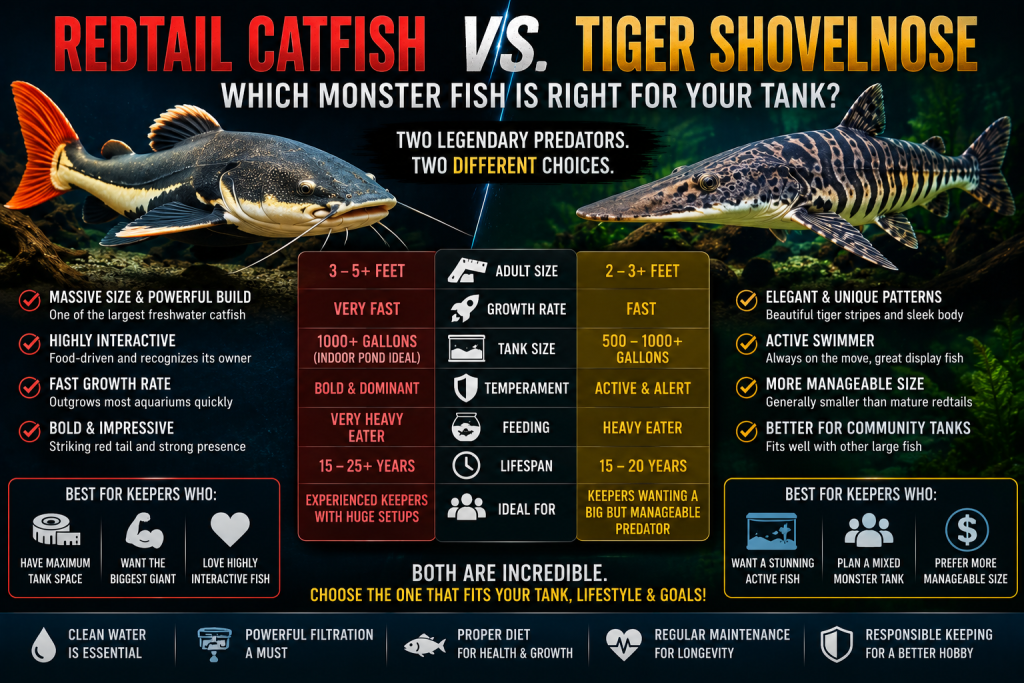
Among the most iconic freshwater monster fish in the aquarium hobby, few species generate as much excitement as the Redtail Catfish and the Tiger Shovelnose Catfish. Both are impressive South American predators known for their massive size, unique appearance, and commanding presence. However, despite some similarities, these two giants differ significantly in growth rate, behavior, care requirements, and long-term suitability for home aquariums. Redtail Catfish vs. Tiger Shovelnose
Many monster fish enthusiasts eventually face the question: should you choose a Redtail Catfish or a Tiger Shovelnose Catfish? The answer depends on your available space, experience level, filtration capacity, and long-term aquarium goals.
This guide compares both species in detail to help you make the right decision before bringing one of these aquatic giants home. Redtail Catfish vs. Tiger Shovelnose
Meet the Redtail Catfish
The Redtail Catfish (Phractocephalus hemioliopterus) is one of the most recognizable freshwater predators in the world.
Native to the Amazon and Orinoco River basins, this species is famous for its enormous size, broad head, long barbels, and bright orange-red tail. Redtail Catfish vs. Tiger Shovelnose
Key Characteristics
- Massive body structure
- Bright red-orange tail fin
- Fast growth rate
- Extremely aggressive feeding response
- Highly interactive personality
The Redtail Catfish has become a favorite among monster fish keepers because of its impressive appearance and bold behavior.
Meet the Tiger Shovelnose Catfish
The Tiger Shovelnose Catfish (Pseudoplatystoma fasciatum) is another legendary South American predator.
Unlike the bulky Redtail, the Tiger Shovelnose possesses a more streamlined body decorated with beautiful striped and spotted patterns.
Key Characteristics
- Elegant elongated body
- Distinctive tiger-like markings
- Active swimmer
- Predatory nature
- Impressive adult size
Many hobbyists consider the Tiger Shovelnose one of the most attractive large catfish species available.
Appearance Comparison
Redtail Catfish
The Redtail Catfish has a thick, muscular build with:
- Large broad head
- White belly
- Dark upper body
- Vibrant orange-red tail
Its appearance communicates power and size.
As it matures, the fish develops a truly imposing presence that dominates almost any aquarium.
Tiger Shovelnose Catfish
The Tiger Shovelnose offers a more refined look.
Its body features:
- Long streamlined profile
- Distinct black stripes
- Silver-gray coloration
- Elegant fin structure
Many collectors choose Tiger Shovelnose Catfish primarily for their beautiful patterns and active swimming behavior.
Size Comparison
One of the biggest differences between these species is adult size.
Redtail Catfish Size
In captivity:
- Commonly reaches 3–4 feet
- Can exceed 5 feet under ideal conditions
- May weigh over 100 pounds
This species quickly outgrows most home aquariums.
Tiger Shovelnose Size
In captivity:
- Typically reaches 24–40 inches
- Occasionally larger
- More manageable than Redtails
While still enormous, Tiger Shovelnose Catfish generally remain smaller than mature Redtails.
Winner: Tiger Shovelnose
Although both species become huge, the Tiger Shovelnose is often easier to accommodate long term.
Growth Rate Comparison
Redtail Catfish Growth
Redtails are infamous for rapid growth.
Juveniles can grow:
- Several inches per month
- Over two feet within a few years
Many beginners underestimate how quickly they develop.
Tiger Shovelnose Growth
Tiger Shovelnose Catfish also grow rapidly but generally at a slower pace than Redtails.
Their more moderate growth allows owners additional time to prepare larger accommodations.
Winner: Tiger Shovelnose
More manageable growth often makes planning easier.
Tank Size Requirements
Neither species belongs in a standard aquarium.
Redtail Catfish Tank Size
Minimum long-term recommendations often exceed:
- 1,000 gallons
- Indoor ponds
- Custom systems
Large adults require enormous swimming space.
Tiger Shovelnose Tank Size
Adult Tiger Shovelnose Catfish generally require:
- 500–1,000 gallons
- Long aquariums
- Heavy filtration
Although still demanding, they typically require less space than mature Redtails. Redtail Catfish vs. Tiger Shovelnose
Winner: Tiger Shovelnose
Slightly more practical for experienced monster fish keepers.
Temperament and Personality
Redtail Catfish Behavior
Redtails are known for:
- Strong feeding response
- Interactive personality
- Curiosity
- Food-driven behavior
Many owners describe them as aquatic puppies because they quickly recognize feeding routines.
Tiger Shovelnose Behavior
Tiger Shovelnose Catfish tend to be:
- More active swimmers
- Slightly less interactive
- More cautious
- Constantly cruising the aquarium
Their activity level often creates a more dynamic display.
Winner: Tie
Both species offer unique personalities.
Feeding Requirements
Both catfish are carnivorous predators.
Redtail Catfish Diet
Common foods include:
- Fish fillets
- Shrimp
- Earthworms
- Carnivore pellets
- Mussels
Redtails possess enormous appetites.
Tiger Shovelnose Diet
Typical foods include:
- Shrimp
- Fish
- Worms
- Quality pellets
- Mussels
Their feeding habits are similar but generally less extreme.
Winner: Tiger Shovelnose
Usually consumes less food overall than an adult Redtail.
Water Quality Demands
Large predators generate significant waste.
Redtail Catfish
Requires:
- Massive biological filtration
- Frequent water changes
- Heavy-duty filtration systems
Their bioload becomes enormous as they mature.
Tiger Shovelnose
Also requires powerful filtration but typically produces less waste than an equivalently sized Redtail.
Winner: Tiger Shovelnose
Slightly easier to maintain.
Compatibility With Other Monster Fish
Redtail Catfish Tank Mates
Possible companions include:
- Arowanas
- Peacock Bass
- Large Stingrays
- Giant Gouramis
However, anything small enough to fit into its mouth may eventually be eaten.
Tiger Shovelnose Tank Mates
Often kept with:
- Arowanas
- Datnoids
- Peacock Bass
- Stingrays
- Large Cichlids
Their streamlined body and active swimming behavior often make them more compatible in large monster fish communities.
Winner: Tiger Shovelnose
Generally integrates more successfully into mixed monster fish displays.
Lifespan Comparison
Redtail Catfish
Average lifespan:
- 15–25 years
- Sometimes longer
Tiger Shovelnose Catfish
Average lifespan:
- 15–20 years
Both require long-term commitment.
Winner: Tie
Both species can remain with their owners for decades.
Cost of Ownership
The purchase price represents only a small fraction of total costs.
Redtail Catfish Costs
Owners must consider:
- Massive aquariums
- Heavy filtration
- Large food consumption
- Increased electricity usage
Tiger Shovelnose Costs
Although still expensive, long-term costs are often lower because of slightly reduced size and waste production.
Winner: Tiger Shovelnose
Typically more economical over the fish’s lifetime.
Which Fish Is Better for Beginners?
The simple answer is neither.
Both species require:
- Advanced planning
- Large aquariums
- Powerful filtration
- Significant financial investment
However, if choosing between the two:
Better Choice for Most Hobbyists
Tiger Shovelnose Catfish
Reasons:
- Smaller adult size
- Slower growth
- Lower bioload
- Easier long-term management
Who Should Choose a Redtail Catfish?
A Redtail Catfish may be ideal if:
- You have access to an indoor pond
- You enjoy giant fish
- You want maximum growth potential
- You appreciate highly interactive fish
Few freshwater species create the same visual impact as a giant Redtail.
Who Should Choose a Tiger Shovelnose?
A Tiger Shovelnose may be ideal if:
- You prefer active swimmers
- You enjoy patterned fish
- You want a large but slightly more manageable predator
- You are building a mixed monster fish community
Many experienced aquarists consider them one of the most beautiful large catfish available.
Final Verdict
Both the Redtail Catfish and Tiger Shovelnose Catfish are incredible monster fish that can become the centerpiece of a large aquarium.
If your goal is owning one of the largest freshwater predators possible and you have the space to support it, the Redtail Catfish delivers unmatched size and personality.
If you want a stunning, active predator that remains somewhat more manageable while still offering impressive size and beauty, the Tiger Shovelnose Catfish is often the better choice.
For most experienced hobbyists, the Tiger Shovelnose provides the best balance of appearance, activity, tank compatibility, and long-term practicality.
Frequently Asked Questions
Which gets bigger, Redtail Catfish or Tiger Shovelnose?
Redtail Catfish generally grow significantly larger than Tiger Shovelnose Catfish.
Can Redtail Catfish and Tiger Shovelnose live together?
In very large aquariums or ponds, they are sometimes kept together successfully.
Which grows faster?
Redtail Catfish typically grow faster and reach enormous sizes more quickly.
Are Tiger Shovelnose Catfish aggressive?
They are predatory but often less dominant than Redtail Catfish.
What size tank does a Redtail Catfish need?
Most adults require systems approaching or exceeding 1,000 gallons.
What size tank does a Tiger Shovelnose need?
Most adults require at least 500–1,000 gallons.
Which is easier to care for?
Tiger Shovelnose Catfish are generally easier due to their smaller size and lower waste production.
Which is better for a monster fish community tank?
Tiger Shovelnose Catfish are often considered more suitable for mixed monster fish setups.
