
Uncategorized
Aquarium Filtration in Canada: How to Choose the Right Filter for Your Freshwater Tank
Nov
A reliable filter is one of the most important pieces of equipment in any aquarium. It keeps water moving, captures debris, supports beneficial bacteria, and helps create stable conditions for fish, plants, shrimp, snails, and other aquatic life. However, choosing the right filter can be confusing when product descriptions focus on flow rates, media capacity, turnover, impellers, and interchangeable cartridges.
This guide explains aquarium filtration in Canada in practical terms. Whether you are setting up a planted community aquarium, an African cichlid tank, a discus system, or a large predator aquarium, the goal is the same: match the filtration system to the livestock, tank size, bioload, and maintenance routine.
Before buying equipment or livestock, you can explore the Monster Aquarium Canada home page to see the types of fish, invertebrates, plants, foods, and aquarium products available for Canadian aquarists.
What aquarium filtration actually does
A filter performs several jobs at once, but filtration is usually divided into three categories: mechanical, biological, and chemical filtration. The best aquarium filters combine at least mechanical and biological filtration, while chemical media can be added when there is a specific reason to use it.
Mechanical filtration
Mechanical media physically traps particles in the water. Foam, filter floss, and fine pads can remove uneaten food, plant fragments, fish waste, and suspended debris. Mechanical media should be easy to remove and rinse because it collects the largest amount of visible waste.
Mechanical filtration improves clarity, but clear water does not automatically mean healthy water. A tank can look clean while ammonia or nitrite is present, so filtration must also provide a strong biological component.
Biological filtration
Biological media provides a large surface area for beneficial microorganisms. These organisms help process toxic ammonia and nitrite produced by fish waste, decaying food, and decomposing plant material. Porous ceramic media, sintered glass, bio-blocks, and mature sponge are commonly used for this purpose.
Biological filtration does not establish instantly. A new aquarium needs time to develop a stable beneficial bacterial population, which is why cycling the aquarium and adding livestock gradually are important steps. Beneficial bacteria also need oxygenated water flow, so an oversized pile of media is not useful if water bypasses it.
Chemical filtration
Chemical media changes or removes certain dissolved substances. Activated carbon may help remove medications, odours, or some organic compounds. Specialty resins can target tannins, phosphate, or other substances, depending on the product.
Chemical filtration is optional in many established freshwater aquariums. It should not be used as a substitute for water changes, suitable stocking, proper feeding, or biological filtration. If you are treating fish, always check whether chemical media should be removed because it may reduce the effectiveness of some medications.
Common aquarium filter types in Canada
There is no single best filter for every aquarium. The right choice depends on tank volume, fish size, available space, noise tolerance, desired flow, and how frequently you want to clean the equipment.
Hang-on-back filters
Hang-on-back, or HOB, filters sit on the rear rim of the aquarium. They are popular because they are straightforward to install, easy to inspect, and suitable for many community tanks. Water is drawn into the filter, passed through media, and returned to the aquarium through a spillway or outlet.
When choosing a HOB filter, look beyond the advertised maximum tank size. Manufacturer ratings are often based on lightly stocked aquariums. A heavily stocked aquarium with active fish may benefit from a larger model or a second filter. Reusable sponge and biological media are usually more useful long term than relying only on disposable cartridges.
Canister filters
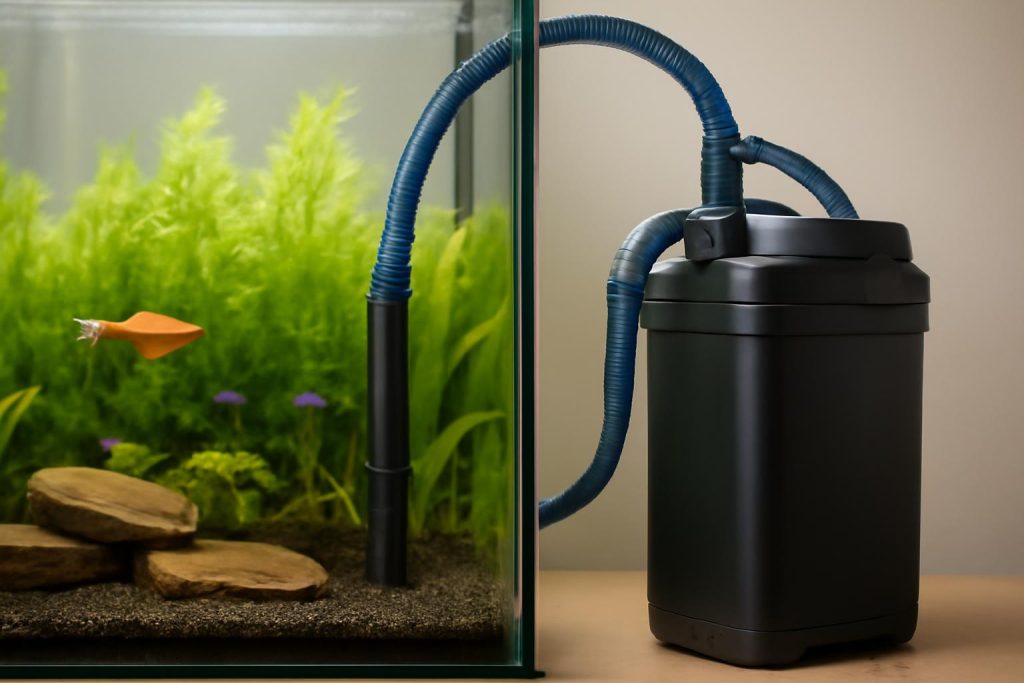
Canister filters sit below or beside the aquarium and move water through a sealed container filled with filtration media. They offer substantial media capacity and can be configured with coarse foam, fine pads, biological media, and optional chemical media.
Canister filters are often a strong choice for planted aquariums, African cichlid setups, discus tanks, and larger freshwater systems. Their return outlets can distribute flow efficiently, but they require careful maintenance. A clogged intake, dirty hose, or poorly seated gasket can reduce performance or create leaks.
Sponge filters
Sponge filters are powered by an air pump. Rising bubbles draw water through a sponge, where particles are trapped and beneficial bacteria grow. They are gentle, inexpensive, and useful for quarantine tanks, breeding tanks, fry aquariums, shrimp tanks, and low-flow setups.
A sponge filter may not provide enough mechanical capacity for a large, heavily stocked aquarium on its own. However, multiple sponge filters can work well in some systems, particularly when redundancy and gentle water movement are priorities.
Internal filters
Internal filters operate inside the aquarium and are compact options for smaller tanks or tanks where external equipment is not practical. They can provide mechanical and biological filtration while taking up some interior space.
Internal filters are useful for beginners, hospital tanks, and temporary systems. Make sure the intake is protected if you keep shrimp, fry, or small fish that could be drawn toward the impeller.
Undergravel and specialized filtration
Undergravel filters pull water through substrate and can provide biological filtration when maintained correctly. They are less common in modern setups but may be suitable for certain simple aquariums. Specialized systems, such as fluidized media filters, sump systems, and moving-bed filters, are generally chosen for larger or more advanced aquariums.
How to size aquarium filtration correctly
Filter sizing should be based on more than the number printed on the box. Consider four factors: actual water volume, fish bioload, swimming behaviour, and media capacity.
Start with real water volume
Aquarium dimensions do not always equal the amount of water inside the tank. Substrate, rocks, driftwood, plants, and internal equipment displace water. A tank marketed by its approximate volume may hold noticeably less water once decorated.
Use the aquarium’s real water volume as a starting point, then consider whether the tank will be lightly or heavily stocked. A lightly stocked planted aquarium and a densely stocked cichlid aquarium may need very different filtration even if they have the same dimensions.
Look at turnover and flow
Turnover describes how many times the filter can theoretically process the aquarium’s water in an hour. The advertised flow rate is usually measured before media becomes dirty and before hoses, lifts, or other resistance reduce output.
More flow is not always better. Fast swimmers and riverine species may appreciate stronger circulation, while bettas, fry, long-finned fish, shrimp, and some gouramis may prefer calmer areas. A good aquarium has movement throughout the tank without forcing every fish to swim continuously against a strong current.
Plan for bioload
Large fish, messy eaters, and active species produce more waste than small, lightly stocked fish. African cichlids, goldfish, plecos, catfish, and monster fish can create a significant bioload as they grow. In these aquariums, choose a filter with generous media capacity and consider using two independent filters.
Two filters can provide useful redundancy. If one unit stops working, the other continues circulating and oxygenating the water. Separate filters can also make maintenance easier because you do not need to clean every piece of biological media at the same time.
Choosing filter media for freshwater fish
A practical media arrangement usually begins with coarse mechanical media, followed by finer mechanical media and biological media. The exact order depends on the filter design, but the goal is to prevent fine debris from quickly clogging the biological section.
- Coarse sponge: captures larger particles and protects the impeller.
- Fine sponge or floss: polishes the water and traps smaller debris.
- Biological media: provides surface area for beneficial bacteria.
- Chemical media: added only when a specific purpose exists.
Reusable media can reduce long-term waste and operating costs. Replace media only when it is deteriorating or no longer functional. Replacing all filter media at once can remove much of the established bacterial population and cause instability.
Filter maintenance without damaging beneficial bacteria
Maintenance should remove accumulated waste while preserving the bacteria that support the aquarium cycle. During a water change, rinse dirty sponges and biological media in a container of removed aquarium water. Avoid rinsing them under untreated tap water because chlorine or chloramine may harm beneficial bacteria.
Clean mechanical media more frequently than biological media. Fine pads may need attention every few days in a heavily stocked aquarium, while biological media may only require occasional gentle rinsing. Inspect the intake, impeller, tubing, spray bar, and return outlet because mineral deposits and debris can quietly reduce flow.
Do not allow a filter to remain stagnant for an extended period. If a filter stops, investigate the cause promptly. Reduced oxygen and trapped waste can affect the media, especially in warm, heavily stocked aquariums.
Special filtration considerations for different aquariums
Planted aquariums
Planted tanks need circulation that distributes nutrients and prevents stagnant areas, but excessive turbulence can drive off carbon dioxide and disturb delicate plants. Use an outlet that spreads flow across the surface or along the length of the aquarium rather than creating one concentrated jet.
Shrimp and invertebrate aquariums
Shrimp, snails, and small aquatic animals can be vulnerable to exposed filter intakes. Use a pre-filter sponge or suitably fine intake guard. This also protects baby shrimp and fry from being pulled into the filter.
When planning a shrimp aquarium, browse the available aquarium product categories and choose equipment that supports gentle, stable water movement.
African cichlid aquariums
African cichlids are active fish that can produce considerable waste, particularly in a well-stocked aquarium. Strong mechanical filtration, dependable biological media, and regular maintenance are important. Position rocks securely and make sure the filter intake cannot become blocked by substrate or decorations.
Discus and warm-water aquariums
Warm water holds less dissolved oxygen than cooler water, so circulation and surface agitation deserve attention in discus and other warm-water systems. Avoid creating excessive turbulence, but maintain enough movement to keep the water oxygenated. Regular water testing and consistent water changes remain essential.
Large predator and monster fish aquariums
Predator fish, red tail catfish, bichir, peacock bass, and other large species require planning beyond the initial juvenile stage. Their adult size, waste production, feeding habits, and potential to move decorations should all influence filtration design.
Large systems often benefit from multiple filters, oversized media capacity, strong intake protection, and easy access for maintenance. Before purchasing a large fish, confirm that the aquarium, filtration, floor support, heating, and long-term maintenance plan can accommodate its adult requirements. You can review current livestock options through the available aquarium livestock and product listings before planning a compatible setup.
Signs that your aquarium filtration needs improvement
Watch for symptoms rather than relying only on the filter’s advertised capacity. Possible warning signs include:
- Persistent cloudy water after the aquarium has matured.
- Visible debris settling throughout the tank.
- Weak return flow or frequent clogging.
- Unpleasant odours from accumulated organic waste.
- Repeated ammonia or nitrite readings.
- Fish gathering near the surface or return outlet.
- Dead spots where debris collects and water barely moves.
These symptoms may result from undersized filtration, excessive feeding, overstocking, inadequate maintenance, or an immature aquarium cycle. Increasing filter size alone will not correct every water-quality problem.
Frequently asked questions about aquarium filtration in Canada
How strong should my aquarium filter be?
Choose a filter rated for at least the actual aquarium volume, then adjust for stocking and species. Heavily stocked tanks and messy fish often need more filtration capacity, while delicate fish may need a baffle, spray bar, or lower outlet flow.
Is one filter enough for a freshwater aquarium?
One filter may be sufficient for a lightly stocked aquarium, but two filters can provide better circulation and backup. Using two units also allows you to service one while the other continues operating.
How often should aquarium filter media be replaced?
Replace media only when it is worn out, collapsing, or no longer usable. Rinse reusable media in removed aquarium water and avoid replacing all biological media at once.
Can a filter be too large for a fish tank?
A filter can create too much current for some fish, but excessive capacity can often be managed with a flow control, spray bar, outlet diffuser, or strategically placed plants and decorations. The aim is strong filtration with suitable water movement.
Do aquarium plants replace a filter?
Plants absorb some nutrients and provide additional biological surface area, but they do not automatically replace filtration. Most community aquariums still benefit from mechanical filtration, circulation, and dependable biological media.
Build filtration around long-term aquarium health
The best aquarium filtration system is one that matches the fish, remains easy to maintain, and provides stable circulation without creating unnecessary stress. Start with the real tank volume, estimate the future bioload, choose durable media, and leave room for additional filtration if the aquarium grows or becomes more heavily stocked.
For aquarists across Canada, dependable equipment is especially valuable when livestock may travel considerable distances or when seasonal temperature changes affect aquarium routines. A well-maintained filter will not replace responsible stocking, quarantine, testing, and water changes, but it will provide the biological and mechanical foundation that helps a freshwater aquarium thrive.
