Uncategorized
Aquarium Water Hardness in Canada: GH, KH, pH, and How to Adjust Them Safely
Nov
Understanding aquarium water hardness in Canada is one of the most useful skills for keeping freshwater fish, shrimp, and aquatic plants healthy. Tap water in Canada can range from very soft to extremely hard depending on local geology, municipal treatment, groundwater sources, and seasonal conditions.
That variation matters. A setup that works perfectly with soft water in one city may require a different approach in a hard-water community elsewhere. Rather than chasing a specific pH number, successful aquarists focus on stability, gradual changes, and choosing livestock that suits their available water.
This guide explains GH, KH, and pH, how to test Canadian tap water, when to use aquarium buffers, and how to create suitable conditions for common freshwater fish, shrimp, plants, and cichlids.
Why Canadian tap water varies so much
Water hardness primarily reflects the minerals dissolved in water. Calcium and magnesium are the most important contributors. Water that passes through limestone or mineral-rich rock often collects more dissolved minerals and becomes harder. Water from areas with granite, sandstone, or certain surface-water sources may be considerably softer.
Municipal water treatment can also influence pH and alkalinity. The water coming from your tap may not have the same chemistry as water from another city, even if both locations are in the same province. Well water can be especially different from nearby municipal supplies.
For aquarists, the practical lesson is simple: do not assume that all Canadian tap water is soft, hard, acidic, or alkaline. Test your own source water before selecting sensitive species or adding chemical products.
GH, KH, and pH: what each measurement tells you
General hardness, or GH
General hardness (GH) measures the concentration of dissolved calcium and magnesium. These minerals support important biological functions in fish and invertebrates. Shrimp, snails, livebearers, and many African cichlids generally benefit from sufficient mineral content.
GH is commonly reported in degrees of hardness, often written as dGH, or in parts per million. A rough guide is:
- Very soft: approximately 0–4 dGH
- Soft to moderately soft: approximately 4–8 dGH
- Moderately hard: approximately 8–12 dGH
- Hard: approximately 12–18 dGH
- Very hard: above approximately 18 dGH
These ranges are guidelines rather than strict rules. Many captive-bred fish adapt to a fairly broad range when the water remains stable.
Carbonate hardness, or KH
Carbonate hardness (KH) describes carbonate and bicarbonate compounds that help resist changes in pH. This buffering capacity is important because biological filtration produces acids as it processes fish waste.
When KH is very low, pH can gradually fall, sometimes causing a dangerous acidification event known as a pH crash. When KH is high, pH is usually more resistant to change and may naturally remain alkaline.
KH is not the same as GH. A tank can have high GH but low KH, low GH but high KH, or high or low levels of both. Test them separately rather than using one measurement as a substitute for the other.
pH
pH measures how acidic or alkaline water is. The scale is logarithmic, so a small numerical change can represent a meaningful chemical difference. However, pH should be interpreted alongside GH and KH. A stable pH that is slightly outside a species’ preferred range is often safer than a pH that is repeatedly adjusted up and down.
How to test aquarium water hardness in Canada
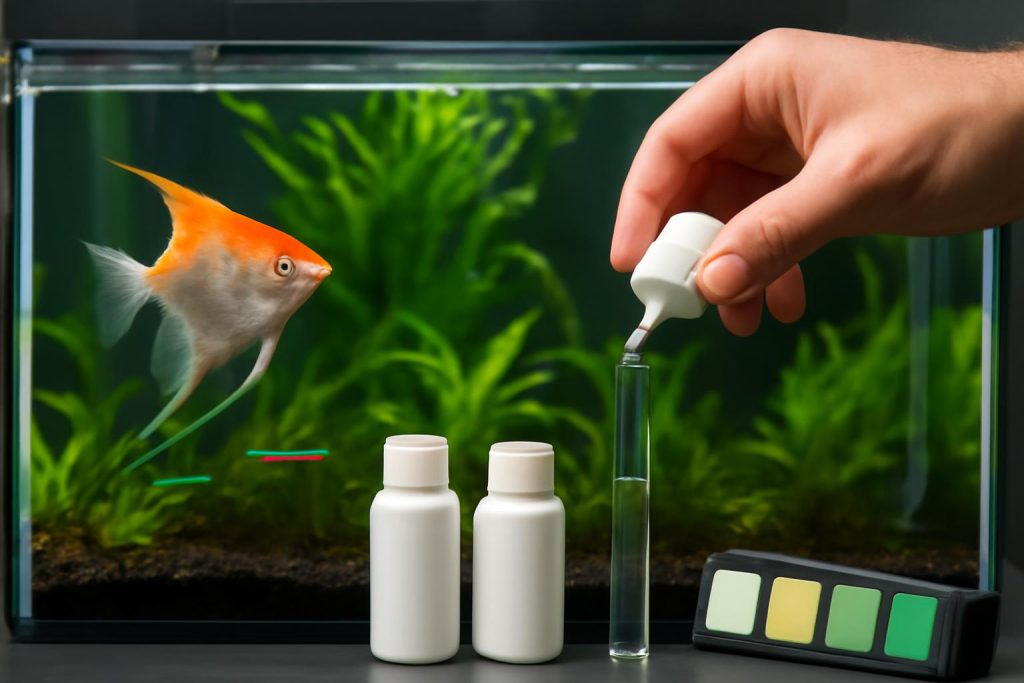
A reliable test routine is more useful than guessing based on the appearance of your water. Use liquid drop tests or quality test strips for GH, KH, pH, ammonia, nitrite, and nitrate.
Test your source water in a clean container before adding conditioner. Then test the aquarium after it has been running for several days. This comparison shows whether gravel, rocks, driftwood, substrate, décor, or filtration media are changing your water chemistry.
It is also helpful to test water at different points in your maintenance cycle. For example, measure immediately before a water change and again a few hours after the new water has mixed. Record the results with the date, water temperature, and percentage of water changed.
Keeping a simple log can reveal gradual trends that a single test misses. If KH steadily declines or pH changes between water changes, your aquarium may need a more consistent maintenance plan.
What water hardness suits common freshwater livestock?
Community fish
Many tetras, rasboras, danios, barbs, rainbowfish, gouramis, corydoras, and plecos can adapt to moderate hardness. The best target depends on the species and its captive-breeding history. Avoid combining fish with dramatically different long-term requirements simply because they are peaceful.
For a general community aquarium, stable moderate GH and KH are often easier to maintain than extremely soft or extremely hard water. A consistent routine, adequate filtration, and controlled stocking usually matter more than achieving a precise number.
Livebearers
Guppies, mollies, platies, and swordtails generally prefer mineral-rich water with moderate to high GH and some carbonate buffering. In very soft water, they may experience mineral-related stress over time, particularly when poor nutrition or unstable pH is also present.
If your tap water is naturally hard, livebearers may be a practical choice. This can reduce the need for ongoing mineral supplementation.
African cichlids
Many Lake Malawi, Lake Victoria, and Tanganyikan cichlids come from mineral-rich, alkaline environments. They usually require stronger buffering and higher mineral content than soft-water community fish. This is one reason cichlid aquariums often use carefully selected rocks, substrates, or commercial buffers.
Different African cichlid habitats are not identical, so avoid treating all African cichlids as one group. Peacock cichlids, mbuna, haplochromis, and Tanganyikan species can have different requirements for territory, diet, tank size, and water chemistry.
When planning a cichlid aquarium, start with your source-water test. Then choose a stable target and adjust replacement water consistently rather than adding products randomly to the display tank.
Discus and other soft-water fish
Discus and some other South American fish are often associated with soft, acidic water. However, the correct conditions depend on the particular stock, breeding history, and supplier’s water. Sudden changes can be more harmful than moderately hard water that remains stable. For related context, see Related guide.
If you keep discus or another sensitive species, ask for the water parameters in which the fish have been maintained and transition gradually. Consistent temperature, excellent filtration, low waste accumulation, and regular testing are essential.
Shrimp and snails
Freshwater shrimp need access to calcium and other minerals for successful moulting. Nerite snails and many other aquarium snails also require adequate mineral availability for shell development. Very low GH can contribute to moulting problems, weak shells, or poor growth.
Do not automatically assume that adding calcium alone will solve a shrimp problem. GH, KH, temperature, total dissolved solids, diet, and water stability all interact. If you use remineralized water, follow the product instructions and measure the result rather than dosing by eye.
Should you adjust your aquarium water?
Not every aquarium needs water modification. If your fish are healthy, your water parameters are stable, and your chosen livestock suits the source water, leaving the water alone is often the safest strategy.
Adjustment may be appropriate when:
- Your livestock has clear long-term mineral or buffering requirements.
- Your KH is too low to maintain stable pH.
- Your GH is insufficient for shrimp, snails, or mineral-demanding fish.
- Your source water is significantly different from the conditions required by a carefully selected species.
- You are breeding fish with specific water chemistry needs.
The goal should be a repeatable water profile, not a perfect test result. Every water change should produce approximately the same GH, KH, and temperature as the previous one.
Using aquarium buffers and remineralizers safely
Commercial aquarium buffers can raise KH and help maintain an alkaline pH. Remineralizers can increase GH, often by adding calcium and magnesium. Some products are formulated for general freshwater aquariums, while others are designed for shrimp, African cichlids, or specific soft-water applications.
Read the label carefully and test before and after dosing. Never add a large amount of buffer based only on a pH reading. A sudden pH or KH increase can stress fish and disrupt their normal adjustment to the water.
For the safest approach, prepare replacement water in a separate container. Add the conditioner and any required minerals, allow the water to mix thoroughly, and test it before adding it to the aquarium. This method makes the final water chemistry easier to control.
If your aquarium needs a buffer at every water change, measure the same volume of replacement water each time and use a consistent dose. Keep notes so you can identify whether the product is producing the intended result.
Natural ways aquarium décor can change water chemistry
Some rocks, coral-based materials, crushed coral, aragonite, and certain substrates can gradually increase GH, KH, and pH. These materials may be useful in hard-water or African cichlid aquariums, but they can be unsuitable for fish that prefer softer, more acidic conditions.
Driftwood and botanicals may release tannins that tint the water and can contribute to a lower pH, especially when KH is low. The effect varies with the amount and type of material used.
If you are troubleshooting water chemistry, test a sample of your source water and a sample from the aquarium. Remove or isolate one suspected item at a time rather than changing several variables simultaneously.
RO water, distilled water, and mixing strategies
Reverse-osmosis (RO) water and distilled water contain very few minerals. They can be useful when tap water is unsuitable, but they should generally be remineralized before fish or invertebrates are added. Pure low-mineral water is not automatically better for aquariums.
Some aquarists mix RO water with tap water to reach a repeatable GH and KH. Others use remineralized RO water for greater control. Both approaches can work, but they require accurate measurement and consistency.
Do not switch an established aquarium from tap water to pure RO water without a plan. A sudden change in mineral content, KH, and pH can create significant stress. Make changes gradually and monitor the aquarium’s response.
A practical water-hardness routine for Canadian aquarists
- Test your tap water: Measure GH, KH, and pH from the source you intend to use.
- Research your livestock: Consider the needs of each fish, shrimp, snail, and plant before stocking.
- Choose stability over perfection: Select a realistic target that you can reproduce during every water change.
- Condition replacement water: Treat chlorine or chloramine according to the conditioner’s instructions.
- Adjust gradually: Use buffers or remineralizers in measured amounts, preferably outside the display aquarium.
- Record results: Keep a log of test readings, water changes, and product doses.
- Watch the livestock: Behaviour, appetite, growth, shell condition, and moulting are useful clues alongside test results.
For aquarists comparing fish, plants, invertebrates, and water-treatment products available across the country, the Monster Aquarium Canada online store provides a starting point for exploring current aquarium options. You can also review the site’s aquarium product categories when planning a new setup or matching livestock with equipment and water-care supplies.
Frequently asked questions
Is hard tap water bad for aquarium fish?
No. Hard water is not automatically harmful. Many livebearers, African cichlids, shrimp, and snails prefer or tolerate mineral-rich water. The important factors are species compatibility, stability, water quality, and gradual acclimation.
Should I lower my aquarium pH if it is higher than expected?
Not necessarily. First measure GH and KH and identify the needs of your livestock. If the fish are healthy and the pH is stable, forcing it lower can create greater risk than leaving it alone. pH-lowering products may also lose effectiveness when KH is high.
Can water conditioner soften hard water?
Most water conditioners neutralize chlorine, chloramine, or certain contaminants; they do not remove the calcium and magnesium responsible for GH. Softening usually requires dilution, reverse osmosis, or another dedicated water-treatment method.
How often should I test GH and KH?
Test when setting up a new aquarium, after changing décor or substrate, when adding livestock, and whenever pH becomes unstable. In an established aquarium, monthly testing or testing during routine maintenance can help identify gradual changes.
Do aquarium plants need hard or soft water?
Plant requirements vary. Many common aquarium plants adapt to a broad range, provided lighting, carbon availability, nutrients, and maintenance are suitable. Extremely soft water may lack minerals needed by some plants, while very hard water can limit certain sensitive species.
Build around the water you can maintain
The best aquarium water plan is one that fits both your livestock and your routine. By measuring GH, KH, and pH, you can make informed decisions instead of reacting to isolated numbers or adding products unnecessarily.
Whether you are keeping community fish, freshwater shrimp, aquarium plants, African cichlids, discus, or larger freshwater species, stable and well-understood water is the foundation of long-term success. Start with your local source water, select compatible livestock, and make every adjustment slowly and consistently.
