Uncategorized
Aquarium Fish Food in Canada: How to Choose a Healthy Diet for Freshwater Fish
Nov
Choosing the right aquarium fish food in Canada is one of the simplest ways to support healthier fish, stronger colour, better growth, and cleaner aquarium water. Yet a food that works well for a school of tetras may be unsuitable for discus, African cichlids, shrimp, goldfish, or large predator fish.
Canadian aquarists also have practical considerations that affect food selection. You may be feeding fish shipped across the country, maintaining a heated tropical aquarium through winter, or caring for species with very different diets in separate tanks. Understanding the basics of fish nutrition helps you buy food with confidence instead of relying only on attractive packaging or a long ingredient list.
This guide explains how to select staple foods, sinking foods, frozen and live foods, specialty diets, and supplements for freshwater aquariums.
Why fish food choice matters
Fish require a balanced supply of protein, fats, vitamins, minerals, and energy. The correct balance depends on the species, age, activity level, and natural feeding behaviour of the fish. Juveniles generally need nutrient-dense food for growth, while adult fish may need a controlled diet that supports maintenance without excessive fat.
Food also affects the aquarium itself. Overfeeding can increase uneaten organic matter, raise nutrient levels, encourage algae, and place additional demand on filtration. Even high-quality food can cause water-quality problems when portions are too large.
A good feeding plan therefore has two parts: choosing a suitable food and delivering an appropriate amount.
Match aquarium fish food to the species
Before choosing a brand or formula, consider what your fish naturally eat and how they feed in the aquarium.
Community fish, tetras, rasboras, and danios
Small schooling fish usually do well on fine flakes, micro pellets, and small granules that remain suspended long enough for the group to feed. Tetras, rasboras, barbs, rainbowfish, and danios often benefit from a varied diet rather than one food used exclusively.
Choose particles that are small enough to swallow comfortably. If food repeatedly falls to the substrate before the fish can eat it, it may be too large or offered too quickly. Occasional frozen or live foods can add variety, particularly for newly acquired fish or species that are reluctant to accept dry foods.
Cichlids
African cichlids, including peacock cichlids, mbuna, haplochromis, Tanganyikan cichlids, and Lake Victoria cichlids, should receive food appropriate to their feeding habits. Many herbivorous or algae-grazing species need a diet that is not dominated by rich animal protein. Other African cichlids are omnivorous or more carnivorous and require a different nutritional balance.
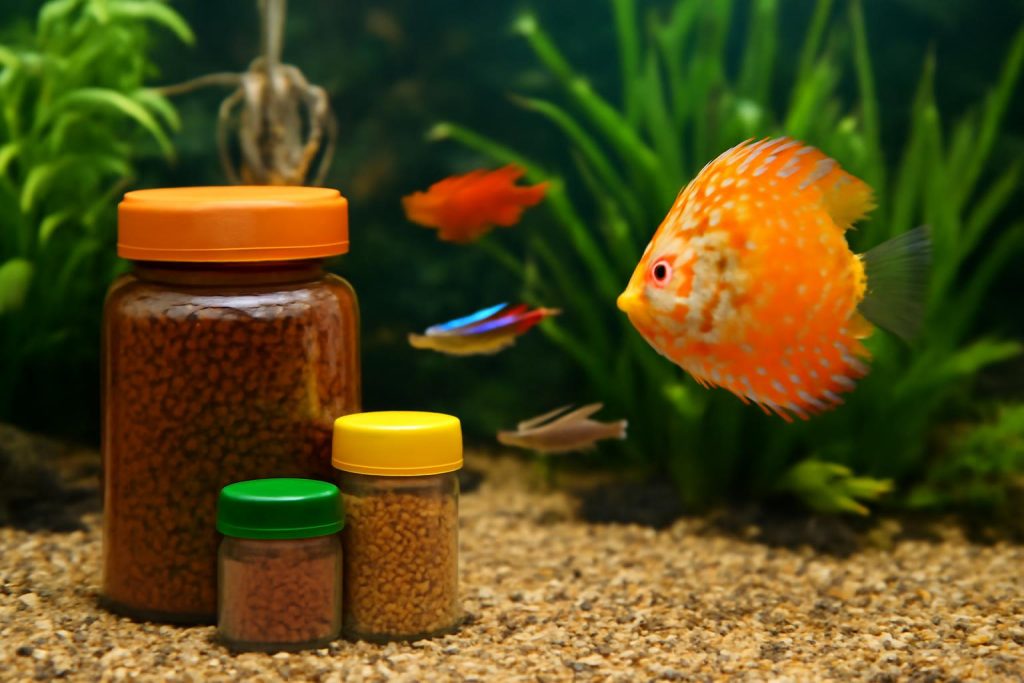
American cichlids, dwarf American cichlids, angelfish, discus, and larger Central or South American species often accept quality pellets, granules, frozen foods, and selected live foods. Discus usually prefer smaller, softer foods that can be consumed without excessive competition. Larger cichlids may need pellets that sink slowly or reach the bottom without disintegrating immediately.
When comparing foods, look for a formula designed for the group you keep rather than assuming that every cichlid food is interchangeable.
Discus and angelfish
Discus and angelfish benefit from highly digestible foods offered in modest portions. Discus are often more sensitive to poor water quality, so uneaten food should be removed promptly. Small granules, quality soft foods, and carefully prepared frozen foods can work well.
Young discus may require more frequent feeding than mature fish because they are growing rapidly. The objective is not to keep food in the aquarium continuously, but to provide enough nutrition while maintaining excellent water quality.
Corydoras, loaches, and plecos
Bottom-dwelling fish need food that actually reaches the substrate. Sinking wafers, tablets, granules, gel foods, and appropriately sized pellets are useful for corydoras, loaches, and many catfish.
Do not assume that bottom feeders will survive on leftovers. Community fish may consume most of the food before it reaches the bottom. Feed sinking foods after the lights have dimmed if appropriate for the species, while still observing the aquarium so you can confirm that the fish are eating.
Plecos have varied nutritional needs. Some species require substantial plant matter, while others consume more animal protein or naturally feed on wood-associated organisms. Research the particular pleco rather than treating every pleco as an algae eater.
Goldfish and koi
Goldfish and koi need food formulated for their digestion and swimming style. Floating pellets make it easier to observe consumption, while sinking foods may reduce surface competition for some fish. Fancy goldfish can be especially sensitive to buoyancy issues, so many keepers prefer diets that sink or soften quickly.
Offer portions that fish can finish promptly. Seasonal changes may affect outdoor koi feeding, and cold water reduces digestion, so feeding should always reflect the actual water temperature and the condition of the fish.
Shrimp, snails, and other aquarium invertebrates
Freshwater shrimp and snails need more than whatever fish leave behind. Shrimp foods, mineral-supported diets, algae-based wafers, and small botanical foods can help provide variety. Snails may graze on biofilm and algae but still benefit from an appropriate supplemental food when natural growth is limited.
Invertebrate foods should be used carefully in small aquariums. A tiny portion is often enough, and uneaten food should not be allowed to decay. You can explore the store’s current aquarium livestock and invertebrate selection when planning a species-specific feeding setup.
Predator and monster fish
Large predators such as bichir, arowana, peacock bass, large catfish, eels, and other monster fish need substantial, species-appropriate nutrition. Large pellets, carnivore formulas, frozen foods, and selected live foods may all have a role depending on the fish.
Feeding large fish does not mean providing unlimited protein. Excess food can lead to rapid but unhealthy growth, fatty deposits, poor water quality, and an oversized biological load. Choose a diet suited to the adult species and monitor body condition as the fish grows.
Common types of aquarium fish food
Flakes
Flakes are convenient for many community aquariums and can be crushed for smaller fish. They are easy to portion, but they may lose quality if exposed to humidity for long periods. Store flakes tightly closed in a cool, dry place and replace them if they develop an unusual smell or remain damp.
Pellets and granules
Pellets and granules are available in floating, slow-sinking, and sinking varieties. They are often easier to portion than flakes and can be selected according to mouth size and feeding zone. A quality pellet should soften appropriately without instantly turning into dust.
NorthFin fish food is one example of a commonly considered staple option for aquarists looking for species-focused dry diets. The correct formula and pellet size still matter, so read the product details and compare them with the fish in your aquarium.
Gel foods
Gel foods, including Repashy-style diets, are useful for fish and invertebrates that prefer soft food or graze over an extended period. They can be shaped, placed on feeding surfaces, or prepared in small batches. Remove leftovers before they begin to break down in the aquarium.
Frozen foods
Frozen foods such as brine shrimp, bloodworms, daphnia, mysis, and other prepared blends can add variety. Thaw only the portion required for a feeding and avoid repeatedly warming and refreezing food. Rinsing thawed foods can reduce some meltwater entering the aquarium, although the best approach depends on the specific product and fish.
Live foods
Live foods can stimulate natural hunting behaviour and are useful for conditioning some fish or encouraging reluctant eaters. Grindal worms, microworms, baby brine shrimp, and other cultures may be suitable for different species and life stages.
Live foods should come from a clean, reliable culture. Introducing organisms from unknown sources can create avoidable health and contamination risks. Use live food as part of a balanced plan rather than as the only diet.
How to read an aquarium fish food label
The ingredient list is useful, but it should be interpreted alongside the guaranteed analysis and the fish species. Look for a formula that identifies appropriate protein sources and does not rely entirely on vague ingredients.
Protein requirements vary widely. A carnivorous predator and an algae-grazing mbuna should not receive identical diets. Also consider fat levels, fibre, added vitamins, colour-enhancing ingredients, and whether the food is intended for fry, juveniles, adults, herbivores, carnivores, or omnivores.
Ingredients are listed by weight before processing, so the first ingredient is not automatically proof that the finished food is perfect for every fish. The most important question is whether the complete formula matches the biology of the species you keep.
Feeding aquarium fish without polluting the water
Start with less food than you think the fish need. A practical portion is one that the aquarium inhabitants consume within a short period, with little or no food settling unnoticed. Fish should look interested and active, but they do not need to be fed until they appear completely full.
- Feed smaller portions when introducing a new food.
- Observe fish at different levels of the aquarium to confirm all species receive food.
- Use feeding rings or targeted feeding tools when appropriate.
- Remove large uneaten pieces with a net or siphon.
- Adjust portions if fish become unusually thin, heavy, or inactive.
- Keep a simple record when feeding multiple tanks or juvenile fish.
Overfeeding is particularly easy with frozen foods and live foods because their moisture content makes portions look smaller than they are. Feed according to the amount of actual food your fish consume, not just the size of the cube or scoop.
Buying aquarium fish food online in Canada
When ordering fish food online, check the product name, formula, particle size, package size, and storage instructions. Buying a very large container may seem economical, but dry food gradually loses freshness after opening. A smaller package may be better for a lightly stocked aquarium.
Consider grouping food orders with water conditioners, bacterial supplements, buffers, health products, or aquarium equipment that you already need. The store’s aquarium product categories can help you review available livestock, foods, supplies, and care products in one place. For new arrivals and educational updates, you can also browse the site’s published aquarium articles.
For aquarists across Canada, delivery timing matters. Store food in a dry location after arrival, inspect packaging for damage, and follow any label instructions before opening. Unlike live fish, dry foods do not usually require temperature-controlled delivery, but extreme heat, moisture, and long storage can still affect quality.
Build a simple diet rotation
A practical diet rotation might include one reliable staple food, one sinking or species-specific food, and an occasional frozen or live option. This approach gives fish variety without creating a complicated routine.
For example, a community aquarium could use a small community pellet as its main food, a sinking tablet for corydoras, and frozen daphnia occasionally. A cichlid aquarium might use a species-appropriate pellet with occasional gel or frozen food. A shrimp aquarium could rely on biofilm and grazing supplemented by small servings of shrimp food and mineral-supported foods.
Change foods gradually when possible. Fish may ignore a new texture at first, and sudden changes can make it difficult to identify the cause if appetite or digestion changes.
Frequently asked questions
What is the best aquarium fish food in Canada?
There is no single best food for every aquarium. The best choice is a fresh, appropriately sized formula that matches the species’ natural diet, feeding behaviour, and life stage. A quality staple can be supplemented with suitable frozen, gel, or live foods.
Can I feed all freshwater fish the same food?
A general community food may work for some mixed aquariums, but it should not be the only food for every species. Herbivorous cichlids, discus, shrimp, goldfish, bottom feeders, and large predators have different nutritional needs.
How often should aquarium fish be fed?
Most adult freshwater fish do well with small, consistent feedings. Juveniles and growing fish may require more frequent meals. The right schedule depends on species, age, water temperature, and body condition, so observe the fish and adjust portions rather than following a rigid number.
Are live foods necessary?
Live foods are not necessary for every aquarium, but they can provide enrichment and variety. A complete commercial diet can support many fish when it is appropriate for the species. Use clean cultures and avoid relying on unknown sources.
How long does fish food stay fresh?
Follow the best-before date and storage instructions, but remember that freshness declines after opening. Keep food tightly sealed, dry, and away from direct heat. Replace food if it smells rancid, becomes damp, or is no longer accepted by fish that previously ate it.
Final thoughts
The right aquarium fish food in Canada should support the fish without compromising water quality. Begin with the species’ natural diet, select an appropriate food size and texture, provide sensible variety, and feed only what the aquarium can process.
Whether you keep tetras, African cichlids, discus, shrimp, goldfish, catfish, or monster fish, thoughtful nutrition is an important part of long-term aquarium care. A well-chosen diet, combined with observation and regular maintenance, helps create healthier fish and a more stable aquarium.
