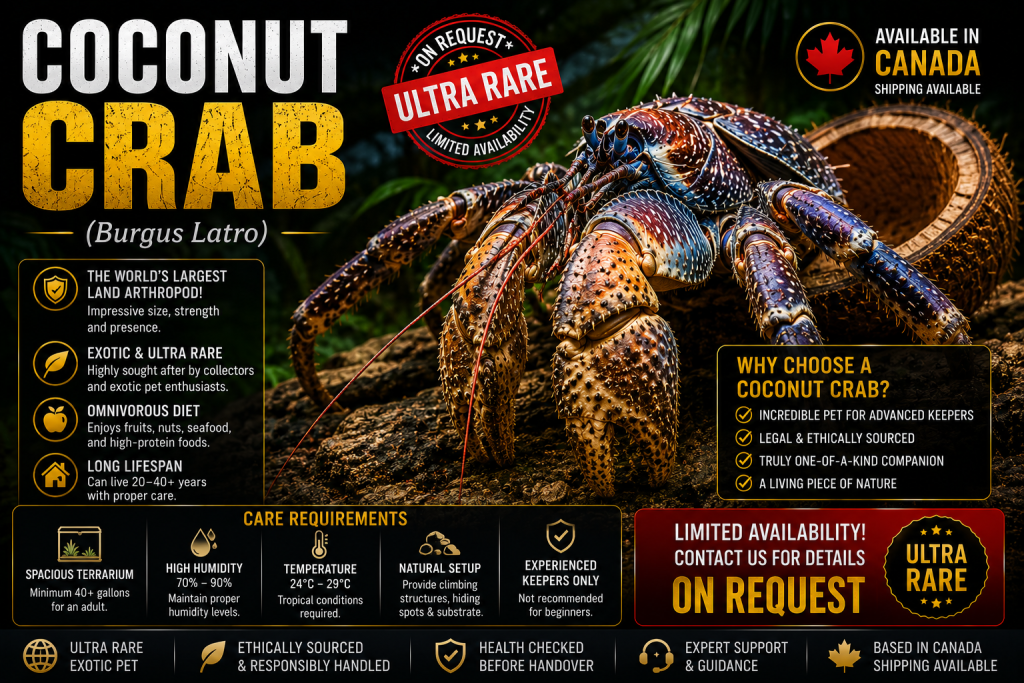
COCONUT CRAB (Birgus latro) – The World's Largest Land Crab
COCONUT CRAB (Birgus latro) – The World’s Largest Land Crab
Jun
The Coconut Crab (Birgus latro) is one of the most extraordinary creatures on Earth. Known as the world’s largest terrestrial arthropod, this remarkable species has captivated wildlife enthusiasts, exotic animal collectors, and nature lovers for generations. With its immense size, incredible strength, impressive climbing abilities, and unique lifestyle, the Coconut Crab stands apart from virtually every other crustacean in existence.
Native to tropical islands throughout the Indian and Pacific Oceans, Coconut Crabs are famous for their ability to climb trees, crack coconuts, and survive primarily on land. Their intimidating appearance combined with their fascinating behavior has earned them a legendary reputation among exotic animal enthusiasts.
Because of their rarity, specialized care requirements, and protected status in many regions, Coconut Crabs remain one of the most sought-after and least commonly encountered terrestrial crustaceans in the world.
What Is a Coconut Crab?
The Coconut Crab belongs to the hermit crab family and is scientifically known as Birgus latro.
Unlike traditional hermit crabs, adult Coconut Crabs eventually outgrow the need for a protective shell. As they mature, their exoskeleton hardens significantly, providing natural protection against predators.
Quick Facts
- Scientific Name: Birgus latro
- Common Name: Coconut Crab
- Family: Coenobitidae
- Native Range: Indian and Pacific Ocean islands
- Lifespan: Up to 60 years
- Diet: Omnivorous
- Conservation Status: Protected in several regions
These fascinating animals represent one of the most unique evolutionary adaptations among crustaceans.
Why Is It Called a Coconut Crab?
The Coconut Crab earned its name because of its famous ability to access coconuts.
Although they do not routinely crack fresh coconuts as often as popular myths suggest, they are capable of:
- Climbing coconut trees
- Harvesting coconuts
- Breaking open damaged coconuts
- Feeding on coconut flesh
Their incredible strength allows them to manipulate objects far larger than most other land-dwelling arthropods.
The World’s Largest Land Arthropod
One of the most remarkable features of the Coconut Crab is its size.
Adult Measurements
- Leg span up to 1 meter (3 feet)
- Body weight exceeding 4 kilograms (9 pounds)
- Massive claws capable of exerting tremendous force
These dimensions make the Coconut Crab the largest terrestrial arthropod currently living on Earth.
Few invertebrates can rival its impressive physical presence.
Incredible Strength
Coconut Crabs possess some of the strongest claws in the animal kingdom relative to their size.
Researchers have found that their pincers can generate enormous crushing force.
This strength helps them:
- Break hard food items
- Defend themselves
- Climb effectively
- Manipulate objects
Their claws are powerful enough to command respect from anyone handling them.
Natural Habitat
Coconut Crabs are found on tropical islands throughout the Indo-Pacific region.
Common Locations
- Christmas Island
- Seychelles
- Cook Islands
- Fiji
- Vanuatu
- Parts of Indonesia
- Various Pacific atolls
They typically inhabit:
- Coastal forests
- Rocky shorelines
- Tropical woodlands
- Burrow systems
Unlike most crabs, they spend nearly their entire adult life on land.
A Life Mostly Spent on Land
One of the most fascinating aspects of the Coconut Crab is its transition from marine beginnings to terrestrial adulthood.
Young larvae develop in the ocean before eventually settling on land.
As adults, Coconut Crabs:
- Breathe air
- Avoid prolonged immersion
- Live in terrestrial habitats
- Return to the ocean only for reproduction
This adaptation makes them highly unusual among crustaceans.
Diet and Feeding Habits
Coconut Crabs are opportunistic omnivores.
They consume a wide variety of foods depending on availability.
Common Foods
- Coconut flesh
- Fruits
- Nuts
- Seeds
- Fallen vegetation
- Carrion
- Small animals
- Other crustaceans
Their excellent sense of smell allows them to locate food from considerable distances.
Climbing Ability
One of the most iconic behaviors associated with Coconut Crabs is tree climbing.
Despite their size and weight, they are excellent climbers.
Reasons They Climb
- Access food sources
- Escape threats
- Explore territory
- Reach coconuts and fruit
Observing a giant Coconut Crab climbing a palm tree is one of nature’s most impressive spectacles.
Behavior and Intelligence
Coconut Crabs display surprising levels of problem-solving ability.
Common behaviors include:
- Investigating new objects
- Manipulating food items
- Exploring territories
- Defending shelters
- Establishing dominance
Their curiosity often surprises people who encounter them in captivity or the wild.
Lifespan
Few crustaceans live as long as Coconut Crabs.
Average Lifespan
- 40–60 years
- Potentially longer under ideal conditions
Their longevity makes them one of the longest-lived terrestrial invertebrates known.
Reproduction
Although adults live on land, reproduction still depends on the ocean.
Reproductive Cycle
- Mating occurs on land.
- Females carry fertilized eggs.
- Eggs are released into the ocean.
- Larvae develop in marine environments.
- Juveniles eventually return to land.
This complex life cycle contributes to their limited distribution.
Conservation Concerns
Coconut Crab populations have declined in certain areas due to:
- Habitat destruction
- Human harvesting
- Coastal development
- Predation by invasive species
Many regions now regulate or prohibit collection to protect wild populations.
Conservation efforts are critical to ensuring the long-term survival of this remarkable species.
Why Coconut Crabs Fascinate Collectors
Exotic animal enthusiasts are often drawn to species that are both unusual and challenging.
The Coconut Crab offers:
- Extraordinary size
- Unique behavior
- Rare availability
- Incredible strength
- Exceptional lifespan
These characteristics make them one of the most talked-about terrestrial invertebrates in the world.
Can Coconut Crabs Be Kept in Captivity?
Coconut Crabs have highly specialized environmental requirements.
Successful long-term care requires:
- Large enclosures
- Tropical temperatures
- High humidity
- Climbing structures
- Appropriate diet
Because of their rarity, legal restrictions, and demanding care needs, they are generally considered suitable only for highly experienced keepers where ownership is legal.
Coconut Crab vs Hermit Crab
Although related, Coconut Crabs differ dramatically from common hermit crabs.
| Feature | Coconut Crab | Hermit Crab |
|---|---|---|
| Adult Size | Up to 9 lbs | Usually a few ounces |
| Shell Use | Juveniles only | Entire life |
| Habitat | Primarily land | Coastal habitats |
| Lifespan | Up to 60 years | Typically shorter |
| Strength | Extremely powerful | Relatively weak |
Their evolution represents one of the most remarkable transformations within the crustacean world.
Fun Facts About Coconut Crabs
They Can Smell Food From Far Away
Their sense of smell is comparable to that of many insects and is highly developed.
They Are Excellent Climbers
Even large adults regularly climb trees.
They Are Related to Hermit Crabs
Young Coconut Crabs initially use borrowed shells.
They Can Live for Decades
Some individuals may survive for over half a century.
They Are Extremely Strong
Their claws are among the most powerful of any arthropod.
Why the Coconut Crab Is a Living Wonder
Few creatures combine size, strength, intelligence, longevity, and uniqueness quite like the Coconut Crab. As the world’s largest land arthropod, it occupies a special place in nature and continues to amaze scientists and wildlife enthusiasts alike.
From climbing palm trees and cracking tough food items to surviving decades in tropical environments, Birgus latro demonstrates just how extraordinary evolution can be. Whether admired for its biology, rarity, or sheer presence, the Coconut Crab remains one of the most fascinating creatures found anywhere on Earth.
Frequently Asked Questions
How big do Coconut Crabs get?
Adult Coconut Crabs can weigh over 9 pounds and reach a leg span approaching 3 feet.
Are Coconut Crabs really the largest land arthropod?
Yes. They are widely recognized as the largest terrestrial arthropod in the world.
What do Coconut Crabs eat?
They are omnivores that consume fruits, coconuts, nuts, seeds, carrion, and other organic matter.
How long do Coconut Crabs live?
Many individuals can live 40–60 years or longer.
Can Coconut Crabs climb trees?
Yes. Despite their size, they are highly capable climbers.
Do Coconut Crabs use shells?
Only as juveniles. Adults develop hardened exoskeletons and no longer require shells.
Are Coconut Crabs rare?
They are uncommon and protected in many parts of their natural range.
Can Coconut Crabs be kept as pets?
Ownership laws vary by location, and their specialized care requirements make them suitable only for experienced keepers where legally permitted.
