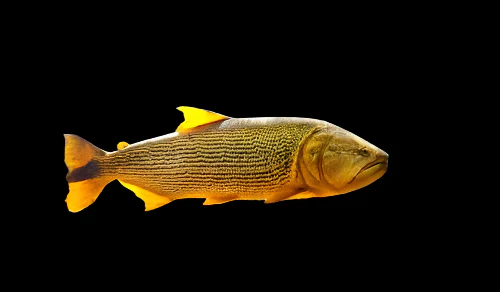
GOLDEN DORADO (Salminus brasiliensis) Wild Caught — RARE
The Golden Dorado (Salminus brasiliensis) is a legendary South American freshwater predator prized by serious monster-fish keepers for its brilliant golden coloration, powerful body, predatory behaviour, and impressive size potential. This wild-caught, rare Golden Dorado offers experienced aquarists an opportunity to keep one of South America’s most iconic predatory fish.
Unlike many aquarium fish that are bred for generations in captivity, a wild-caught Golden Dorado represents a fish collected from its natural environment. Its powerful swimming ability, predatory instincts, and demanding space requirements make it a specialty species for experienced aquarists.
Monster Aquarium Canada offers rare freshwater fish for Canadian hobbyists seeking exceptional predatory and monster-fish species.
Species Overview
The Golden Dorado belongs to the genus Salminus, a group of powerful South American freshwater predators. Salminus brasiliensis is widely recognized as the Golden Dorado and is closely associated with major river systems of South America.
This species is built for active hunting. It has a streamlined, muscular body, large mouth, strong jaws, and a powerful tail designed for fast swimming and pursuing prey.
Scientific Name
Salminus brasiliensis
Common Names
- Golden Dorado
- Dorado
- South American Dorado
- River Dorado
- Golden River Fish
Origin
Golden Dorado are native to freshwater river systems of South America, particularly major basins in countries including Brazil, Argentina, Bolivia, Paraguay, and Uruguay.
Wild fish inhabit rivers and tributaries where strong swimming ability and predatory behaviour provide an advantage.
Appearance and Coloration
The Golden Dorado is famous for its golden-yellow coloration and muscular appearance.
Depending on age, locality, condition, and lighting, a mature fish can display:
- Brilliant golden body coloration
- Yellow-orange fins
- Metallic scales
- Darker back
- Strong lateral body patterning
- Large mouth
- Powerful caudal fin
- Streamlined predator’s body
Wild-caught specimens can have particularly impressive natural coloration and body development.
Why Choose a Wild-Caught Golden Dorado?
Golden Dorado are highly sought after by monster-fish enthusiasts because they combine beauty with powerful predatory behaviour.
Key Features
- RARE aquarium species
- Wild caught
- Powerful South American predator
- Brilliant golden coloration
- Extremely active swimmer
- Impressive adult size
- Strong predatory instincts
- Highly desirable collector fish
- Unique alternative to common monster fish
Aquarium Setup
The most important consideration when keeping a Golden Dorado is space.
This is not a small community aquarium species. Golden Dorado are powerful, active swimmers that require substantial open swimming space.
For long-term adult care, a very large aquarium or custom indoor pond is recommended. A system measuring several hundred gallons may be appropriate depending on the size and number of fish, but larger is better.
Open Swimming Space
Unlike sedentary bottom-dwelling monster fish, Golden Dorado spend considerable time swimming throughout the water column.
Provide:
- Large uninterrupted swimming areas
- Strong water movement
- Secure covers
- Robust filtration
- High oxygenation
- Durable decorations
Avoid overcrowding the aquarium with unnecessary decorations.
Filtration
Golden Dorado produce substantial waste and require excellent filtration.
A large sump, high-capacity canister filtration, or a properly engineered pond filtration system can be used depending on the aquarium design.
Mechanical filtration should be cleaned regularly, while biological filtration should be sufficiently oversized for the fish’s eventual adult size.
Water Parameters
Maintain clean, highly oxygenated freshwater.
Recommended conditions include:
- Temperature: approximately 22–28°C
- pH: approximately 6.0–7.5
- Soft to moderately hard water
- High dissolved oxygen
- Ammonia: 0 ppm
- Nitrite: 0 ppm
- Low nitrate
Stable conditions are particularly important with wild-caught fish during the acclimation period.
Acclimation of Wild-Caught Fish
Wild-caught Golden Dorado should be given time to acclimate to aquarium conditions.
During the initial period:
- Minimize unnecessary disturbance
- Provide excellent oxygenation
- Maintain stable temperature
- Monitor water quality closely
- Offer appropriately sized food
- Avoid overcrowding
- Observe behaviour carefully
Wild-caught specimens may initially behave differently from captive-raised fish and can require patience while adapting to a new environment.
Diet and Feeding
Golden Dorado are carnivorous predators.
Suitable foods can include:
- High-quality carnivore pellets
- Fish-based prepared foods
- Shrimp
- Krill
- Earthworms
- Insects
- Appropriately sized frozen foods
- Whole prey where appropriate
A varied diet is preferable to feeding one food exclusively.
For long-term aquarium health, prepared predator foods should form an important part of the feeding program where the fish accepts them.
Avoid excessive feeding of fatty feeder fish, which can contribute to nutritional problems and poor water quality.
Behaviour and Temperament
Golden Dorado are active predators with powerful swimming ability.
They can be extremely energetic, particularly when feeding. Their predatory instincts mean that smaller fish may be viewed as prey.
They are best maintained with appropriately sized fish in very large systems.
Tank Mates
Potential companions must be:
- Large enough to avoid predation
- Fast enough to avoid constant harassment
- Compatible with similar water conditions
- Able to tolerate an active predator
Avoid small community fish, ornamental nano species, shrimp, and other animals that can fit into the Golden Dorado’s mouth.
Growth and Adult Size
Golden Dorado can become very large fish.
Wild specimens can reach well over 2 feet, with exceptionally large individuals becoming considerably larger. Aquarium growth depends on genetics, nutrition, water quality, temperature, swimming space, and overall husbandry.
Because this listing represents a wild-caught fish, buyers should plan for substantial future growth rather than choosing an aquarium based on its current size.
Compatibility With Monster Fish
Golden Dorado can potentially be maintained with other appropriately sized monster fish in an extremely large system.
Possible combinations depend heavily on individual temperament and size.
The biggest consideration is avoiding fish that are small enough to be swallowed or species that cannot tolerate the Golden Dorado’s constant activity.
Rarity and Collector Appeal
The Golden Dorado is particularly attractive to collectors because it is not a typical community aquarium fish.
Its combination of:
- Wild-caught origin
- Golden coloration
- Predatory behaviour
- Large adult size
- Powerful swimming ability
- South American origin
makes it a specialty species for advanced monster-fish aquariums.
Golden Dorado Wild Caught for Sale in Canada
Looking to buy a rare Golden Dorado in Canada? Monster Aquarium Canada specializes in unusual freshwater fish for serious Canadian aquarists and collectors.
This wild-caught Salminus brasiliensis should only be purchased by an experienced fishkeeper capable of providing a very large, secure, highly filtered aquarium or indoor pond.
Customers searching for rare Golden Dorado in Toronto, Ontario, Vancouver, British Columbia, Calgary, Alberta, Montreal, Quebec, Winnipeg, Manitoba, and other Canadian locations should confirm current availability and shipping requirements before ordering.
Wild-caught livestock availability, size, condition, coloration, and inventory can change. Shipping availability may also depend on the destination and current livestock shipping conditions.
Frequently Asked Questions
1. How big does a Golden Dorado get?
Golden Dorado can exceed 2 feet in length, with very large wild specimens becoming considerably larger.
2. Is the Golden Dorado suitable for a regular community aquarium?
No. Its large adult size, high activity level, and predatory nature make it a specialty fish requiring a very large aquarium or pond system.
3. What does a Golden Dorado eat?
It is a carnivorous predator that can consume quality predator pellets, shrimp, krill, insects, earthworms, and other appropriately sized foods.
4. Can Golden Dorado live with other monster fish?
Potentially, but tank mates must be appropriately sized and compatible with an active predatory fish. Smaller fish may be eaten.
5. What does “wild caught” mean?
Wild caught means the fish was collected from its natural habitat rather than being raised entirely in captivity. Wild-caught specimens may require additional acclimation and careful observation after arrival.
Be the first to review “Golden Dorado Salminus brasiliensis for Sale Canada | Rare Wild Caught”
Related products
Reviews
There are no reviews yet.