White Tail Acei (Pseudotropheus sp. “Acei” Ngara) 1.5″ – African Mbuna Cichlid for Sale in Canada
Add an active and distinctive Lake Malawi cichlid to your aquarium with the White Tail Acei (Pseudotropheus sp. “Acei” Ngara), a juvenile African mbuna measuring approximately 1.5 inches. Recognized by its attractive body colour and contrasting pale tail, the White Tail Acei is a popular choice among hobbyists who appreciate colourful, active and social Malawi cichlids.
Acei cichlids are especially interesting because their behaviour and natural habitat differ from those of many other rock-dwelling mbuna. They are commonly associated with rocky areas near submerged wood and can spend considerable time swimming in open water rather than remaining close to rock crevices.
At Monster Aquarium Canada, we offer specialty African cichlids for Canadian aquarium enthusiasts. This young White Tail Acei is an appealing option for hobbyists who want to raise a juvenile and watch its appearance and behaviour develop.
White Tail Acei – Appearance and Characteristics
Distinctive White Tail Colouration
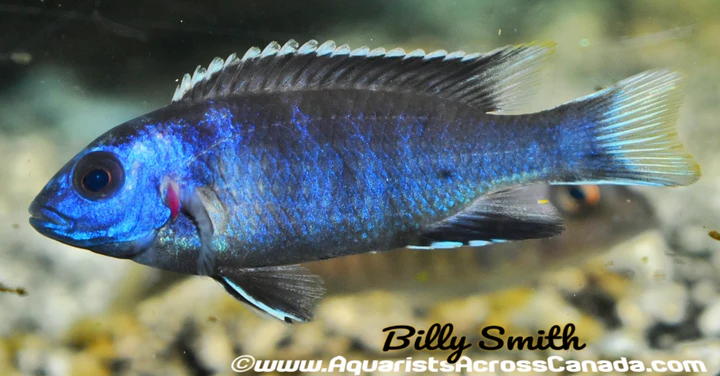
The White Tail Acei is known in the aquarium trade for its contrasting pale or whitish tail, which gives the fish its common name. Its body colour can vary with the individual, maturity, breeding background and aquarium conditions.
The contrast between the body and tail makes this variety particularly attractive in a Lake Malawi display. As the fish matures, its body proportions and colour expression may become more pronounced.
Factors that influence its appearance include:
-
Genetics and breeding background.
-
Age and maturity.
-
Water quality and overall health.
-
Diet and nutritional condition.
-
Social environment and stress levels.
-
Aquarium lighting and surroundings.
Because this listing is for a juvenile measuring approximately 1.5 inches, its final adult appearance may continue to develop.
Understanding the Acei Ngara Identification
The supplied listing identifies this fish as Pseudotropheus sp. “Acei” Ngara. The abbreviation “sp.” indicates that the listing uses a genus-level identification rather than a fully specified scientific species name.
“Acei” and “Ngara” are aquarium-trade and population-related names used in the hobby. Buyers interested in maintaining a particular geographical population or breeding line should confirm the supplier’s identification and lineage information.
Juvenile 1.5-Inch Specimen
At approximately 1.5 inches, this fish is a young specimen with room to grow. Juvenile Acei may not yet display all the characteristics associated with mature individuals.
If you are planning a breeding group, ask about the fish’s sex and whether it can be reliably identified at its current size.
Natural Habitat and Behaviour
Acei cichlids originate from Lake Malawi in East Africa. They belong to the mbuna group, a broad collection of cichlids associated with rocky shorelines.
Although many mbuna spend much of their time defending small rock territories, Acei are known for their more open-water swimming behaviour. They may gather in groups and move around the aquarium together.
Temperament and Social Behaviour
-
Temperament: Generally moderately territorial.
-
Activity: Active swimmer, often using open aquarium space.
-
Social behaviour: Can be kept in groups with suitable space.
-
Habitat preference: Rocky areas with open swimming zones.
-
Compatibility: Best with carefully selected Lake Malawi cichlids.
Acei are often considered less aggressive than some mbuna varieties, but they are still African cichlids with individual territorial behaviour. Compatibility should always be assessed rather than assumed.
Aquarium Setup and Tank Requirements
Recommended Tank Size
A 55-gallon aquarium may accommodate a carefully planned Acei setup, but a tank of approximately 75 gallons or larger is preferable for a group or mixed mbuna community.
Acei are active swimmers, so horizontal swimming space is particularly useful. Larger aquariums also make it easier to manage territories and reduce persistent aggression.
Substrate and Decoration
Create a Lake Malawi-inspired environment with a combination of rocky structures and open swimming areas.
Recommended aquarium features include:
-
Fine sand or smooth aquarium substrate.
-
Securely arranged rocks and caves.
-
Open swimming space.
-
Strong biological filtration.
-
Good water circulation and oxygenation.
-
A secure aquarium cover.
Avoid filling the entire aquarium with rocks. Acei benefit from room to swim, while rockwork provides shelter and visual separation.
Water Parameters for White Tail Acei
Lake Malawi cichlids generally require warm, alkaline and mineral-rich water. Stable conditions are essential for healthy growth and long-term wellbeing.
| Parameter | Recommended range |
|---|---|
| Temperature | 76–82°F (24–28°C) |
| pH | 7.8–8.6 |
| General hardness | Approximately 10–20 dGH |
| Carbonate hardness | Approximately 8–15 dKH |
| Ammonia | 0 ppm |
| Nitrite | 0 ppm |
| Nitrate | Preferably below 20 ppm |
Maintain a fully cycled aquarium and perform regular partial water changes. Avoid sudden changes in temperature, pH or hardness.
Feeding and Nutrition
A Balanced Diet for Acei Cichlids
Acei are commonly associated with feeding on algae and other organic material found around their natural habitat. A suitable diet should include quality plant-based and algae-based foods.
Recommended foods include:
-
Spirulina-based African cichlid pellets.
-
Algae-based formulated foods.
-
Vegetable-based cichlid flakes.
-
Suitable plant-based sinking pellets.
-
Quality foods formulated for herbivorous or omnivorous mbuna.
Feed small portions once or twice daily, adjusting the quantity to the fish’s appetite and condition. Remove uneaten food to maintain water quality.
Avoid making rich, high-protein animal foods the main part of the diet. A balanced feeding routine is important for digestive health.
Tank Mates and Compatibility
Suitable Lake Malawi Tank Mates
White Tail Acei can be considered for a carefully planned Malawi mbuna aquarium. Select companions based on adult size, temperament, feeding requirements and water conditions.
Potential companions may include appropriately selected:
-
Other compatible Acei varieties.
-
Less aggressive Malawi mbuna.
-
Suitable Lake Malawi cichlids with similar water requirements.
Avoid housing them with highly aggressive species that may continually chase or injure them. Very small peaceful community fish are also unsuitable companions.
Keeping Acei in Groups
Acei are often maintained in groups, provided the aquarium has enough swimming space and filtration capacity. A group can display interesting social behaviour, but stocking should be planned around adult size and the balance of males and females.
Monitor the group for chasing, fin damage and competition at feeding time.
Breeding Considerations
Acei are maternal mouthbrooders. After spawning, the female carries fertilized eggs and developing fry in her mouth until the young are ready to become independent.
If breeding is your goal, confirm the fish’s identification and lineage. Avoid mixing different Acei populations or varieties without understanding the potential for crossbreeding.
Why Choose White Tail Acei from Monster Aquarium Canada?
The White Tail Acei (Pseudotropheus sp. “Acei” Ngara) 1.5″ is an attractive option for hobbyists who enjoy active Lake Malawi cichlids and want to raise a young fish in a suitable African cichlid aquarium.
Monster Aquarium Canada focuses on specialty freshwater livestock for Canadian aquarium enthusiasts. Before ordering, confirm current availability, individual specimen photographs, actual size, sex if known, identification details and delivery eligibility for your province or territory.
Provide a mature, properly cycled aquarium, suitable group planning, stable water conditions and a balanced algae-based diet to support healthy development.
Frequently Asked Questions
1. What is a White Tail Acei cichlid?
White Tail Acei is an aquarium-trade name for an Acei-type Lake Malawi mbuna recognized for its contrasting pale tail and distinctive appearance.
2. How large is this White Tail Acei?
This listing is for a juvenile measuring approximately 1.5 inches. It will grow considerably as it matures, so plan its aquarium around its adult requirements.
3. Can White Tail Acei be kept in groups?
Yes. Acei are often maintained in groups when sufficient aquarium space, filtration and suitable social conditions are provided.
4. What should I feed White Tail Acei?
Offer a balanced diet based on spirulina pellets, algae-based foods and suitable vegetable-based cichlid foods. Avoid relying heavily on rich animal-protein foods.
5. Can White Tail Acei live with other mbuna?
Yes, with careful selection. Choose compatible Lake Malawi cichlids with similar water requirements and manageable aggression. Provide open swimming space and sufficient rockwork.
Be the first to review “White Tail Acei Cichlid 1.5″ for Sale in Canada”
Related products
All African Cichlids
All African Cichlids
All African Cichlids
All African Cichlids
SCIAENOCHROMIS FRYERI *electric blue* (HOUSEBRED, DOMESTIC) 5-6″ MALE
All African Cichlids
All African Cichlids
All African Cichlids
All African Cichlids
Reviews
There are no reviews yet.