Uncategorized
African Cichlid Tank Setup in Canada: A Practical Guide to Mbuna, Peacocks, and Haps
Nov
African cichlids are among the most colourful and engaging freshwater fish available to Canadian aquarists. Their bold patterns, active behaviour, and fascinating social dynamics make them excellent display fish, but they need a planned environment rather than a generic community aquarium.
A successful African cichlid tank setup in Canada starts with choosing the right group of fish. Mbuna, peacock cichlids, and haplochromis may all come from the African Great Lakes, but they differ in temperament, adult size, diet, and preferred layout. Water chemistry, filtration, stocking density, and tank mates also deserve attention before you place an order.
This guide explains the main decisions in a practical way so you can build a healthier, more stable aquarium from the beginning. It is an evergreen care guide, not a claim about a current aquarium trend or seasonal market change.
Choose the right African cichlid group
The phrase “African cichlid” covers several different types of fish. Selecting a group based only on colour can lead to aggression, incompatible diets, or a tank that becomes too small as the fish mature.
Mbuna
Mbuna are rock-dwelling cichlids commonly associated with Lake Malawi. Many species are highly territorial, especially around caves and feeding areas. They are active, hardy, and colourful, but their aggression needs to be managed through suitable stocking and plenty of broken sight lines.
Mbuna usually benefit from a rock-heavy aquarium with multiple territories rather than a wide-open layout. Species such as some labidochromis, pseudotropheus, and metriaclima can work in a carefully planned setup, but compatibility should always be considered at the species level.
Peacock cichlids
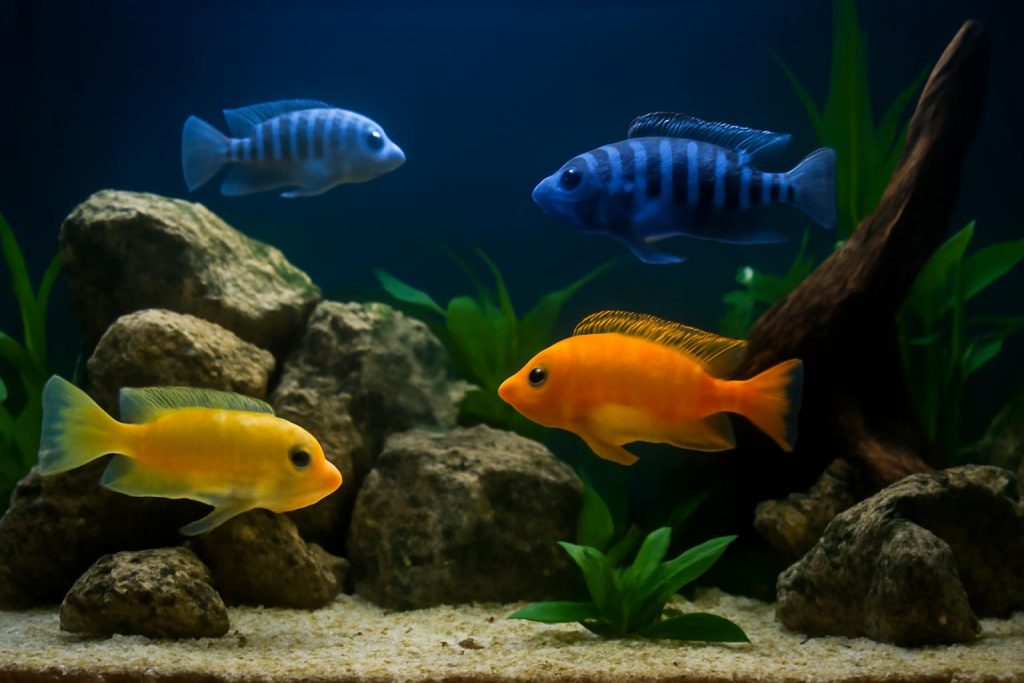
Peacock cichlids, generally from the genus Aulonocara, are known for bright blue, yellow, orange, and red colouration. They are often calmer than many Mbuna, although individual males can still become territorial.
Peacocks typically look best in a tank with open swimming space, sand or fine substrate, and selected rocks that provide cover without filling the entire aquarium. Avoid combining them with highly aggressive Mbuna unless the aquarium is large, carefully stocked, and managed by an experienced keeper.
Haplochromis and other Malawi haps
Haplochromis-type cichlids, often called haps in the aquarium hobby, include many larger and more active fish. They generally require more swimming room than smaller Mbuna and may prey on very small tank mates.
Haps can be an excellent choice for a larger aquarium, especially when you want a display focused on open water movement and impressive adult size. Research the expected adult length before buying juveniles, since a small fish can eventually require a substantially larger home.
Tanganyikan and Lake Victoria cichlids
Lake Tanganyika species have their own specialised behaviours and habitat needs. Shell dwellers, frontosa, Julidochromis, Tropheus, and other Tanganyikan cichlids should not automatically be mixed with Malawi fish. Lake Victoria cichlids also deserve species-specific planning, particularly because aggression and availability can vary.
For the most predictable result, build the aquarium around one lake and one compatible fish community. You can explore Monster Aquarium Canada when comparing available African cichlids and planning your livestock list.
How large should an African cichlid aquarium be?
There is no single tank size that suits every African cichlid. Adult size, activity level, aggression, and the number of fish all matter. A small group of less aggressive dwarf or smaller-bodied species may be appropriate for a medium aquarium, while larger haps and complex communities need considerably more space.
As a general planning principle, prioritise tank length and footprint over height. A longer aquarium gives territorial fish more room to establish boundaries and allows subordinate individuals to move away from dominant fish. Extra water volume also makes temperature and water chemistry more stable.
Before purchasing, write down:
- The expected adult length of every species.
- The minimum recommended group size.
- The number of males and females you plan to keep.
- The territory each fish may defend.
- The space needed for rocks, filtration, and open swimming.
Do not size the aquarium based on the juvenile fish you see in a listing. Plan for adult dimensions and behaviour. If a species is known to be particularly aggressive or predatory, allow more space than a basic stocking chart suggests.
Water chemistry for African cichlids in Canada
Many African cichlids prefer alkaline, mineral-rich water. This can be convenient for aquarists in parts of Canada where tap water is naturally hard, but local water differs between municipalities and even between seasons. Test your source water before selecting fish.
Important measurements include:
- pH: African Rift Lake cichlids generally prefer alkaline conditions, but stability is more important than chasing an exact number.
- GH: General hardness indicates the concentration of minerals in the water.
- KH: Carbonate hardness helps buffer pH and resist sudden changes.
- Ammonia and nitrite: Both should remain at zero in a properly cycled aquarium.
- Nitrate: Keep it controlled with water changes, good filtration, and sensible feeding.
Use a reliable water conditioner whenever preparing tap water. If your water is very soft, an appropriate aquarium buffer or mineral supplement may help create more stable conditions. Add products according to measured results rather than guessing. Sudden pH changes can be more stressful than a slightly imperfect but stable value.
Test freshly mixed water and the aquarium itself. If you use reverse-osmosis water, remember that it usually needs remineralisation before it is suitable for African cichlids.
Designing the aquarium: rocks, substrate, and sight lines
Decor should serve the fish, not just the appearance of the room. African cichlids use rocks and caves as boundaries, hiding places, spawning sites, and escape routes.
Rockwork and stability
Choose aquarium-safe rocks with no sharp edges that could injure fish. Arrange larger pieces securely before adding substrate or water. Cichlids may dig and rearrange the bottom, so unstable rock piles can collapse and damage the aquarium.
For Mbuna, create several separated territories instead of one large cave that a dominant fish can control. For peacocks and haps, combine a few shelters with open swimming space. Avoid blocking all areas of the aquarium; subordinate fish need places to retreat without being trapped.
Substrate
Fine sand is popular because many cichlids sift it through their mouths while searching for food. It also creates a natural-looking contrast with rockwork. Rinse substrate carefully before use, and avoid materials that can contain contaminants or sharp fragments.
Plants
Plants are optional. Many African cichlids dig, graze, or pull at vegetation, making delicate rooted plants difficult to maintain. Hardy plants attached to rocks or wood may work in some setups, but the aquarium should not depend on plants for biological filtration.
Filtration and maintenance
African cichlids are active fish and can produce a substantial amount of waste, particularly in a fully stocked aquarium. Use filtration with enough biological media and mechanical capacity for the tank’s adult bioload.
A combination of a canister filter, hang-on-back filter, or appropriately sized internal filtration can work. The best choice depends on the aquarium volume, stocking plan, maintenance routine, and available space. Aim for strong circulation without creating exhausting, chaotic flow.
Clean mechanical media when it becomes clogged, but avoid replacing all biological media at once. Rinse reusable media in removed aquarium water rather than untreated tap water. This helps protect the beneficial bacteria that process fish waste.
Weekly maintenance commonly includes a partial water change, substrate cleaning where appropriate, inspection of equipment, and testing of key parameters. Heavy feeding, high stocking, or a new aquarium may require more frequent attention.
Stocking and aggression management
Stocking an African cichlid aquarium is a balance. Too few fish can allow one dominant individual to focus all its aggression on a single target. Overstocking, however, can overwhelm filtration and leave the fish in chronically poor water quality.
Some keepers use a relatively full stocking plan to distribute aggression, but this approach requires excellent filtration, disciplined water changes, and close observation. It is not a substitute for a suitable aquarium size or compatible species.
When introducing new fish, rearranging the rockwork can help reset established territories. Add fish with the aquarium lights reduced, and monitor the tank closely for persistent attacks, torn fins, rapid breathing, or fish that remain trapped in a corner.
Do not mix species solely because their colours look attractive together. Avoid combining fish with dramatically different adult sizes, diets, or aggression levels. A peaceful peacock may struggle in a tank dominated by aggressive Mbuna, while small fish may become targets for large haps.
Feeding African cichlids
Diet should match the fish. Many Mbuna are adapted to grazing algae and biofilm, while peacocks and haps often accept a more protein-rich omnivorous or carnivorous diet. Feeding the wrong food too often may contribute to digestive problems and poor condition.
Use a quality staple pellet or flake designed for the group you keep. Offer small portions that the fish consume quickly, generally once or twice daily depending on age, size, and activity. Juveniles may require more frequent meals, while adult fish benefit from controlled portions.
Supplement variety carefully with suitable frozen or prepared foods. Avoid overfeeding simply because the fish appear eager. Uneaten food breaks down into ammonia and nitrate, encouraging water-quality problems and excess algae.
Ordering African cichlids online in Canada
Buying fish online can give Canadian aquarists access to a broader selection than a nearby local store, including specific colour forms, less common species, and different size options. The quality of the purchase depends on preparation as much as the shipment itself.
Before ordering, confirm that your aquarium is fully cycled and stable. Have a suitable quarantine or observation plan ready, even when fish arrive from a reputable seller. Prepare a clean container, temperature-matched water, a net or specimen container, and a calm place for the fish to settle.
Review the seller’s livestock instructions, delivery schedule, weather policy, and live-arrival process before checkout. Canadian travel distances and seasonal temperatures can affect delivery planning, so avoid placing an order when you cannot receive it promptly. During cold weather, ask about insulation and heat-pack procedures where applicable.
You can browse the available aquarium products and use the store’s listings to compare species, sizes, foods, equipment, and care supplies. Product availability changes, so always read the individual listing carefully rather than relying on a general category name.
Common mistakes to avoid
- Buying fish before cycling the aquarium.
- Choosing species by colour without researching adult behaviour.
- Using a small tank for fish that will grow into large haps or predators.
- Adding unstable rocks that can collapse when fish dig.
- Changing pH rapidly with unmeasured buffers.
- Overfeeding to encourage faster growth.
- Adding new fish without considering quarantine or observation.
- Ignoring aggression because a fish is still a juvenile.
Frequently asked questions
Are African cichlids suitable for beginners?
They can be, provided the aquarium is properly cycled and the fish are selected carefully. Smaller, less aggressive species may be easier than large predators or complex mixed communities. Beginners should start with a clear stocking plan rather than adding random species over time.
Can Mbuna and peacock cichlids live together?
It is possible in some large, carefully managed aquariums, but it is not always ideal. Mbuna may be more aggressive and may outcompete peacocks for food and territory. A species-focused setup is usually easier to manage.
Do African cichlids need live plants?
No. Rockwork, caves, stable water chemistry, and good filtration are more important. Hardy plants may be added if they tolerate digging and grazing, but plants are not essential to a healthy cichlid aquarium.
How often should I change the water?
Many aquariums benefit from regular weekly partial water changes, but the exact schedule depends on stocking, filtration, feeding, and test results. Use ammonia, nitrite, and nitrate readings to confirm whether your routine is keeping the water safe.
Where can I find African cichlid supplies in Canada?
Start by comparing livestock, food, water-treatment products, and equipment from a specialised online fish store. The aquarium product categories can help you locate relevant fish groups and supplies, while individual product pages provide the details needed for a responsible purchase.
Build for the adult fish, not the shopping cart
The best African cichlid aquarium is planned around long-term care. Choose one compatible lake community, size the tank for adult fish, create secure territories, maintain stable mineral-rich water, and match feeding to the species. With those foundations in place, Mbuna, peacocks, haps, and other African cichlids can become active, colourful centrepieces for aquarists across Canada.
